
I used to think I was pretty good at reading Ziggy.
Then one afternoon at the pet store he went from “fine” to dragging me across the parking lot in under thirty seconds. Looking back at the video later, the signs had been there the whole time. I just didn’t have a system for noticing them fast enough.
That is the problem most of us face. Dog body language is continuous and layered. A single signal rarely means much on its own. Context matters. Clusters matter. And by the time the obvious stuff appears—barking, lunging, freezing solid—the dog is already past the point where easy intervention works.
The Red-Yellow-Green Stress Scale is the tool I built for myself after that parking-lot moment. It is deliberately simple. You can run it in about thirty seconds once you practice. It is not a diagnostic test and it is not a replacement for professional help when behavior is complex. It is a practical filter that helps you catch rising stress early and adjust before the situation becomes unmanageable.

Why a Traffic-Light System Works
Dogs do not escalate from relaxed to reactive in one jump. Research on canine communication and stress consistently shows a progression. Early signals (often called displacement or calming signals) appear first: lip licking when no food is present, out-of-context yawning, turning the head away, a brief freeze, weight shifting backward. If those go unanswered, the dog moves into more overt signs of distress or defense.
The ladder of communication used by many behavior professionals formalizes this idea. Lower rungs are subtle and easy to miss. Higher rungs are harder to ignore and harder to recover from quickly. The goal of any practical scale is to keep the dog on the lower rungs as much as possible.
Color coding simply makes the categories memorable under pressure. Green means the dog is coping well. Yellow means the nervous system is under load and needs support or distance. Red means the dog is over threshold—learning is impaired, and the priority is safety and recovery, not training.
I tested versions of this with Ziggy for months. Maple, being older and more stoic, rarely hit red, but she taught me that yellow can look very quiet in some dogs. The scale improved once I stopped treating every dog the same and started watching clusters instead of isolated gestures.
The Scale Itself
Use the whole picture: eyes, ears, mouth, tail, posture, and movement. One signal alone is information. Three or more in the same direction is a clear category.
Green – Coping and Available
Body is soft and loose. Weight is evenly distributed. Eyes are soft or gently blinking. Mouth is relaxed—slightly open or closed without tension. Tail is in its normal carriage for that dog, moving loosely if it moves at all. The dog can take food, respond to simple cues, and shift attention between the environment and you.
Green does not mean the dog is ecstatic. It means the current situation is within their capacity. Learning and positive associations can happen here.
Yellow – Under Load, Needs Adjustment
You will see combinations of the early signals. Common ones include:
Lip or nose licking when no food is nearby
Yawning that is not related to tiredness
Whale eye (the white of the eye visible as the head turns away while the gaze stays fixed)
Ears shifting back or to the side
Weight shifting onto the hind legs
Brief freezes or slower movement
Closed mouth that was previously open
Sudden ground sniffing or shaking off as if wet
The dog may still take food, but often with a harder mouth or less enthusiasm. They may respond to cues more slowly. Yellow is the most useful zone for intervention because the dog is still reachable. Increase distance from the trigger, reduce intensity, add predictability, or end the exposure. Small changes here prevent the jump to red.
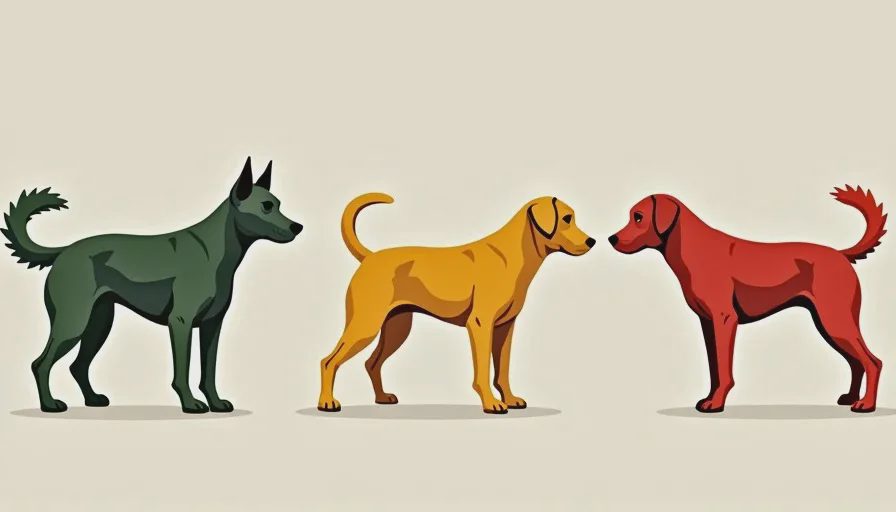
Red – Over Threshold
The body becomes rigid or extremely low. Eyes may be hard and fixed or showing clear whale eye. Mouth is tightly closed or open in a pant that is not heat- or exercise-related. Tail is tucked tightly or held high and stiff. The dog may freeze completely, attempt to flee, or move into defensive displays (growling, lunging, barking). Food is usually refused or taken and immediately dropped. Cues are ignored.
At red the priority is safety and recovery. Create distance, end the situation if possible, and give the dog time and space to come back down. Training in this state is ineffective and can make future associations worse.
How to Use It in Real Life
Start by observing your dog in low-stakes situations at home. Note their personal baseline. Some dogs hold their ears differently; some have naturally higher tail carriage. The scale is relative to the individual.
Then practice on walks or in mildly novel environments. Glance at the whole dog every few seconds when something changes—another dog appears, a truck passes, a person approaches. Ask yourself: green, yellow, or red? If yellow, act. If red, manage.
I keep a mental checklist:
Eyes and mouth
Ears and head position
Weight and overall posture
Ability to take food or respond to a known cue
Thirty seconds is enough once the pattern is familiar. The goal is not perfect accuracy on the first try. The goal is earlier recognition than you had before.
Context still rules. A yawn after a long walk is different from a yawn while a stranger leans over the dog. A lip lick while waiting for dinner is different from a lip lick when a child reaches for the collar. Always read the cluster against the situation.
What This Scale Does Not Do
It does not diagnose medical pain or illness. Sudden changes in body language, especially if they appear without an obvious environmental trigger, warrant a veterinary check. It does not replace a full behavior assessment for serious issues such as aggression or severe anxiety. And it does not give you permission to push a yellow or red dog “through it.” The research on learning and stress is consistent: dogs learn poorly when their nervous system is overloaded, and forced exposure can strengthen fear.
What the scale does give you is a shared language. When I work with clients I can say “he just went yellow at the corner” and we both know what adjustment is needed. At home it keeps me honest with Ziggy. I still miss signals sometimes. The difference is that I notice the miss faster and correct course sooner.
Respect the dog means reading what they are actually saying, not what we wish they were saying. The Red-Yellow-Green scale is simply a practical way to listen.