Ziggy was under the dining table, shaking, while I stood in the kitchen holding my car keys and trying not to cry. That was my first real look at dog separation anxiety. I had thought I was dealing with barking and a little clinginess. Instead, my terrier mix was panicking because I might leave. The difference matters: this is not revenge, stubbornness, or a dog trying to make your day harder.
Dog separation anxiety is a fear response linked to being alone or separated from a particular person. A dog may vocalize, pace, scratch doors, destroy objects, drool, eliminate indoors, or attempt to escape. Some dogs show subtler signs, such as refusing food, staring at the exit, or following their guardian from room to room. Respect the dog means reading those signs as information, not moral failure.
What Dog Separation Anxiety Actually Looks Like
Many dogs dislike departures without having a clinical anxiety problem. The useful question is what happens before, during, and after you leave. Does your dog begin panting when you pick up your bag? Do they stop eating a stuffed toy once you close the door? Does the behavior appear only when they are completely alone, or also when another family member remains home?
A camera can reveal details you would otherwise miss. Record a short departure with an inexpensive indoor camera or an old phone placed safely out of reach. Watch for a predictable sequence: orienting toward the door, scanning the room, pacing, whining, and escalating into scratching or frantic movement. Note the time each step begins. For Ziggy, the first stress signals appeared within two minutes, long before the dramatic barking I had been measuring.
Other causes can overlap. Pain, urinary disease, noise sensitivity, confinement distress, medication changes, and cognitive changes in older dogs can all affect behavior. A veterinarian should evaluate sudden onset, nighttime confusion, self-injury, vomiting, or major changes in appetite and thirst.
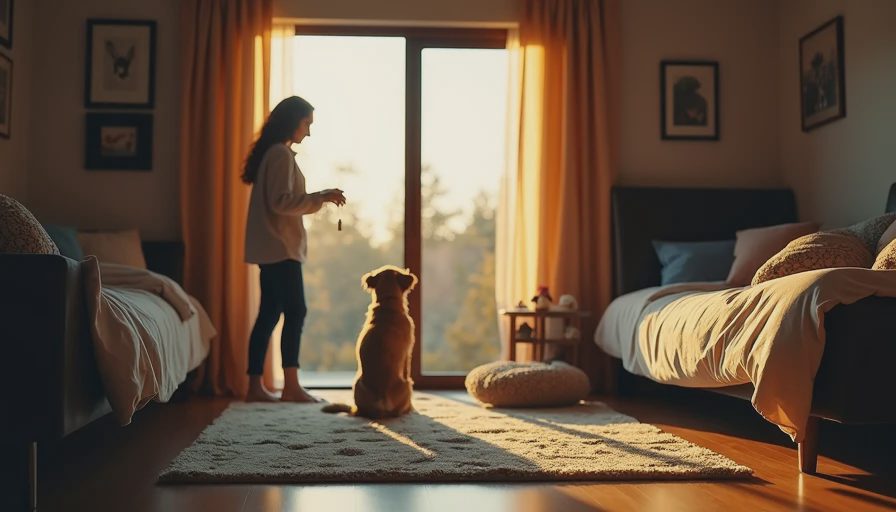
The First Job Is Preventing Panic
Training cannot work well if your dog repeatedly practices full-blown panic. For a while, management is not giving in; it is creating enough safety for learning to happen. Ask a trusted friend, neighbor, dog walker, or sitter for help. Some families use daycare for selected days, although daycare is not suitable for every dog. Bringing a dog to work, rotating errands, or taking them along can also reduce unavoidable absences while you build a plan.
Make departures boring and predictable. Close curtains if outside activity is a trigger, use white noise if hallway sounds cause alerting, and provide a comfortable resting area rather than forcing a crate. If your dog panics in a crate, do not assume more crate time will solve it. Confinement can intensify fear in a dog whose central problem is isolation.
Management also includes removing escape hazards. Secure blinds, keep medications and food behind closed doors, and move furniture away from windows. A panicked dog can break a tooth, cut a paw, or ingest something dangerous in minutes. The goal is not perfect obedience. The goal is fewer rehearsals of terror.
A Gentle Training Protocol
Start below the point where your dog becomes worried. This might mean standing behind an interior door for one second, stepping back, and returning before your dog follows or vocalizes. Repeat several times, then pause. The next session might involve two seconds, but only if the earlier step remains calm. Progress is measured in relaxed body language, not in how long you can force a separation.
Use a simple traffic-light system. Green means your dog can notice the separation and continue eating, sniffing, or resting. Yellow means they stop the activity, stare at you, or begin moving toward the door. Red means panting, vocalizing, scratching, frantic movement, or refusal of a favorite food. Return to green. If your dog reaches red, the exercise was too difficult, not proof that training is failing.
Dog separation anxiety training often involves many tiny repetitions rather than heroic absences. Practice departure cues separately: pick up keys, then sit down; put on shoes, then make tea; open the door, then close it. This reduces the predictive power of those cues. Food can help, but a dog who will not eat is communicating that the emotional load is too high.
Build a Departure Log That Tells the Truth
My product-manager instincts finally became useful when I stopped relying on memory. Create columns for date, starting duration, pre-departure cue, body language, food interest, recovery time, and what changed in the environment. Write observations instead of judgments. “Paced for 40 seconds and licked lips” is more useful than “acted weird.”
Keep one variable stable whenever possible. If you change the duration, the room, the treat, and the time of day all at once, you will not know what helped. Increase difficulty gradually, and reduce it after a rough session. A good week may include several easy repetitions and only a small increase in duration.
This log also helps identify patterns. Some dogs cope better after a sniff walk; others are more unsettled when overtired. Some struggle with evening departures but handle midday practice. Dog separation anxiety is not a character trait, so the same dog can have very different responses across contexts.

When Professional and Veterinary Support Matters
Get help promptly if your dog injures themselves, destroys doors or windows, cannot eat during absences, loses house-training, or escalates despite careful management. An IAABC-certified behavior consultant or a veterinary behaviorist can help distinguish separation-related behavior from noise fear, confinement distress, or another problem. Look for professionals who explain their plan, collect data, and avoid shock collars, intimidation, and flooding.
Talk with your veterinarian about whether anti-anxiety medication might be appropriate. Medication is not a shortcut or a failure. For some dogs, it lowers the panic enough that gradual behavior work becomes possible. Your veterinarian must decide whether medication fits your dog and how it should be monitored; do not use human medication or change a prescription independently.
A qualified professional can also help you plan for unavoidable absences. If a dog cannot yet manage thirty seconds alone, leaving for eight hours is not a training test. It is an overwhelming event. Build the support system first, then teach the skill in manageable pieces.
A Practical Starting Plan for This Week
On day one, schedule a veterinary appointment if the behavior is sudden, severe, or accompanied by physical symptoms. Set up a camera and record a normal departure. On day two, identify your dog’s earliest yellow signal and create three easy separation exercises that end before it appears. On day three, arrange backup care for necessary errands.
For the rest of the week, practice two or three brief sessions when your dog is calm. Change only one detail at a time. End while your dog is still successful, then record what happened. If the dog reaches red twice, make the next session easier rather than pushing through.
Dog separation anxiety can be exhausting for everyone in the household. I have cried on the kitchen floor, canceled plans, and wondered whether I had made Ziggy worse. Careful work did not produce a neat overnight transformation, but it gave us information, choices, and eventually more peaceful departures. Your dog is not giving you a hard time; they are having a hard time. Start where they can cope, protect that threshold, and build from there. Respect the dog.


Talkback
0