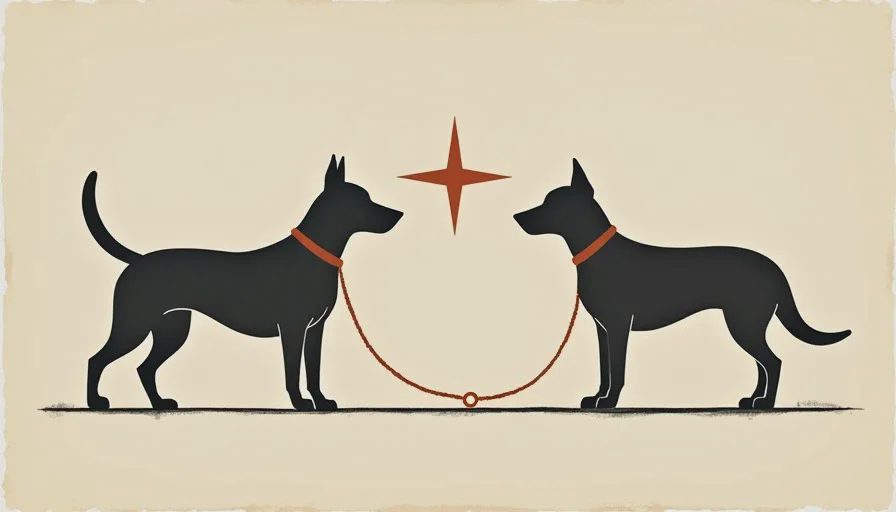
The first time Maple corrected Ziggy hard enough for me to notice, I almost intervened.
Ziggy had been bouncing around her resting space, mouthy and persistent, ignoring the first few signals. Maple lifted her head, gave a hard stare, and produced a low, unmistakable growl. Ziggy froze, then backed away. Maple put her head back down. The entire exchange lasted a few seconds.
My hand had already moved toward them. I stopped myself. Nothing had escalated. No one was trapped. The younger dog had received clear information and adjusted. The older dog had used the minimum force required to be understood.
I sat with the discomfort of not jumping in. That discomfort turned out to be useful.
The “Never Let Them Work It Out” Rule Needs Nuance
There is a good reason many trainers and behavior people say you should not let dogs “work it out.” Unmanaged conflict can produce injuries, reinforce bullying, traumatize the more vulnerable dog, and create lasting tension in the household. Flooding a fearful dog with the presence of a pushy one is not training. It is a welfare failure.
That advice is correct in a large percentage of real homes. It is especially correct when the dogs are poorly matched in size, when one is already fearful or recovering from trauma, when resources are scarce, or when the humans cannot read the difference between communication and escalation.
It becomes less useful when it hardens into a blanket rule that every growl must be interrupted and every disagreement must be managed by the human. Dogs have a language for social negotiation. If we suppress every signal, we do not eliminate the need for negotiation. We only remove the quieter tools and leave the dogs with fewer options.
Maple had quieter tools. She used them first. The growl appeared only after the stare and body language had been ignored. That sequence matters.

What I Was Actually Watching For
I do not have a romantic view of dogs sorting themselves out. I have a practical checklist.
I intervene or prevent when:
One dog is repeatedly targeting the other despite clear signals to stop.
The intensity escalates quickly instead of resolving.
Either dog is cornered or cannot increase distance.
There is a size or strength mismatch that makes even a brief conflict risky.
Resource guarding is intensifying around food, resting places, or people.
The younger or more vulnerable dog is shutting down, avoiding whole areas of the house, or showing chronic stress signals.
I am more likely to let a moment complete itself when:
The older or more stable dog is using proportional, low-intensity signals.
The receiver adjusts and the interaction ends.
Both dogs have space and an exit.
The overall relationship is not characterized by chronic harassment or fear.
I am present and able to step in immediately if the picture changes.
Maple’s correction of Ziggy met the second list. Ziggy was being a nuisance. Maple answered clearly. Ziggy listened. The household returned to baseline. If I had rushed in to “correct” Maple for growling, I would have punished the very communication that kept the situation small.
What Maple Taught Ziggy (and Me)
Ziggy arrived with poor social skills and a nervous system that spent a lot of time elevated. He did not automatically read the difference between an invitation and a “not now.” Maple provided consistent, readable feedback. She was not harsh. She was clear.
Over weeks, Ziggy began to approach her resting places with more care. He offered more distance. He redirected to toys or to me more often when she was settled. Maple, in turn, became more tolerant of his presence at the edges of her space. The relationship improved because information was allowed to travel between them.
I still managed the environment. Separate resting zones. Enough beds that neither had to compete for the good one. Feeding apart. Toys rotated so high-value items did not become flashpoints. Supervision during the early months. None of that contradicted allowing Maple to deliver a clean, proportional correction when Ziggy ignored her first requests.
The goal was never “let them fight it out.” The goal was “do not suppress functional communication between two dogs who are capable of using it.”

Where People Get This Wrong
Some owners see any correction from one dog to another as dominance or bullying and shut it down. Others swing the opposite direction and refuse to intervene even when one dog is clearly overwhelmed or the interactions are becoming unsafe. Both extremes create problems.
Functional household relationships usually sit in the middle. The dogs are allowed to speak. The humans set the conditions that keep speech from turning into harm. When a stable dog says “that is enough” and the other dog listens, the system is working. When signals are ignored, intensity climbs, or one dog lives in a chronic state of avoidance, the system needs help.
I also had to watch my own bias. Ziggy was the project dog, the one I was actively rehabilitating. Maple was the easy one. It would have been simple to over-protect Ziggy from every social consequence and, in the process, rob him of the chance to learn from a dog who was better at dog communication than I am. Maple’s feedback was part of his education.
The Practical Middle Path
If you live with more than one dog, the useful questions are concrete:
Can each dog increase distance when they need to?
Are resources arranged so that conflict is less necessary?
Is the overall pattern one of occasional clear signals followed by recovery, or one of repeated targeting and escalating tension?
Do you know the difference, for your specific dogs, between a proportional correction and the start of a fight?
When the answers point to safety and functional communication, stepping back for a moment is not neglect. It is allowing information to move. When the answers point to risk or chronic stress, management and intervention are the responsible choice.
Maple is older now. She still sets boundaries. She still does it with economy. Ziggy still tests them occasionally and still adjusts when she answers. I still watch. The difference is that I no longer treat every growl as an emergency. Some of them are simply a senior dog continuing to teach a younger one how to live in a shared space.
Respect the dog.

Talkback
0