When people learn we have two dogs, the question usually arrives quickly: Do they get along?
It is the wrong first question. The better one is whether the environment makes getting along the easy option.
Maple and Ziggy are not a matched pair. She is older, selective, and efficient with her energy. He is younger, more intense, and still learning how to share space without turning every moment into a transaction. Left to a free-for-all of food bowls, favorite beds, and unrestricted access to us, they would have produced far more friction than they do. The relative peace in our house is not proof that they are naturally harmonious. It is the result of deliberate arrangement.
Resource sharing in a multi-dog home is less about teaching dogs to be generous and more about reducing the reasons they need to compete.
Food Is Not a Community Activity
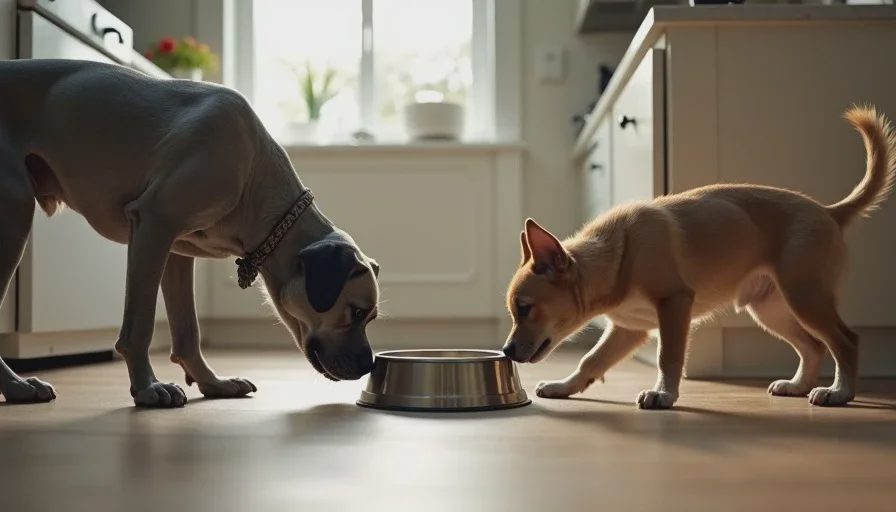
We feed them separately.
Not in different rooms every time, but with enough distance and clarity that neither feels the other is a threat to the meal. Bowls are set down apart. I stay present for the first part of the meal when either dog is in a phase of higher arousal. High-value chews and stuffed toys are given in controlled contexts, not dropped into the middle of the living room for whoever claims them first.
This is not because I believe dogs must never see each other eat. It is because mealtime is one of the easiest places for tension to build, and tension is cumulative. A dog who eats while scanning the other dog is not fully settling. A dog who finishes first and moves in on the second bowl is practicing a pattern I do not want strengthened.
Early on, Ziggy’s interest in Maple’s food was higher. Maple’s response was a hard stare and, if needed, a shift of her body that clearly said the bowl was not communal. I did not punish her for that communication. I changed the setup so she rarely needed to use it. Separate stations and clear endings to the meal removed most of the pressure.
If I am giving something especially valuable—a new chew, a long-lasting item—I often separate them completely for the duration. Freedom to disengage matters as much as the item itself.
Resting Places Are Infrastructure
Beds are not decorations. They are infrastructure.
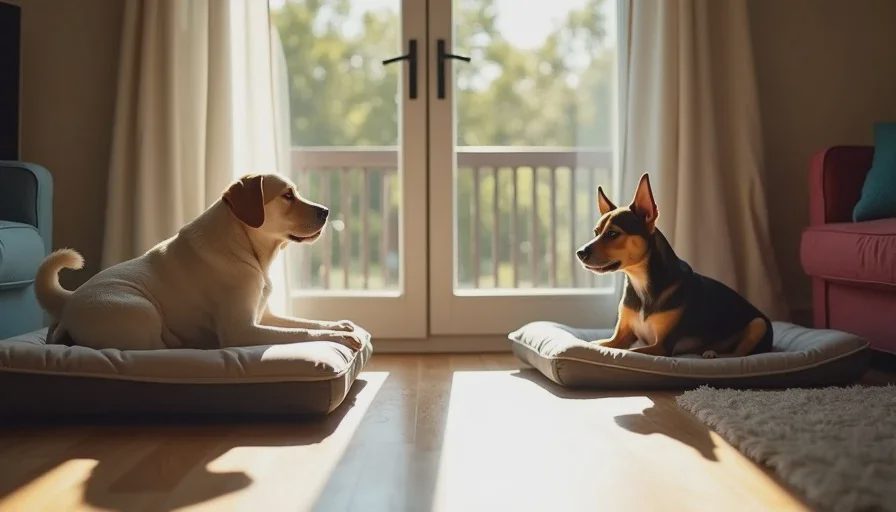
We keep more resting places than dogs. At least one elevated or orthopedic option that Maple prefers. At least one that Ziggy claims. A couple of secondary options so that if one is occupied or in a high-traffic zone, another exists. The goal is that neither dog has to displace the other to get comfortable.
Maple cares about this more than Ziggy does. She has preferred locations that shift with the season and the light. When Ziggy was new and still learning household rules, he would sometimes try to insert himself into her space. Her corrections were clear and proportional. My job was to make sure he had equally good alternatives and that the environment did not force repeated confrontations over the same square of floor.
I also protect rest. If Ziggy is in a restless phase, Maple is not required to serve as his living comfort object. She can remove herself. He can be redirected to a legal outlet or a settle on his own bed. Chronic interruption of a senior dog’s rest is not “cute bonding.” It is a welfare issue for the older animal.
Toys and the Myth of Automatic Sharing
Some dogs share toys easily. Many do not, and there is nothing morally superior about the ones who do.
We rotate toys rather than leaving everything available at once. High-value items are introduced with management. If a particular toy consistently produces stiff body language or blocking, it becomes a single-dog item used in separate sessions. Play between the dogs is allowed when both are clearly opting in and when either can leave. It is interrupted when one is persistent past the other’s signals.
I do not force sharing as a training exercise. I teach that good things appear when both dogs are settled near me, and I arrange the environment so that valuable objects are not a constant test. The absence of daily conflict is a better measure of success than whether they can pass a toy back and forth on cue.
Human Attention Is a Resource Too
This one is easy to miss.
Dogs notice where we look, where we sit, and who gets the first greeting at the door. In a multi-dog home, attention can become a contested resource even when food and beds are well managed. Ziggy arrived already oriented toward people as a source of safety. Maple has always been more moderate in her demands. The imbalance could have turned into persistent interruption of her quiet time or into competition at every transition.
I greet them in a way that does not require a scramble. I make a point of reinforcing Maple for calm presence so that the quieter dog does not disappear from the reinforcement landscape. When Ziggy is demanding, I do not always answer the demand. I wait for a moment of neutrality or a settle, then pay that. Maple is never required to yield her resting place simply because the younger dog wants to be closer to me.
None of this is cold. It is structured. Predictable access to attention reduces the need for pushy behavior. It also protects the older dog from becoming background furniture in her own home.
A Working Checklist for Multi-Dog Resource Management
These are the questions I return to when something feels off:
Can each dog eat without being approached or stared at?
Are there enough resting places that both can be comfortable at the same time?
Do high-value items appear in controlled contexts rather than as open competitions?
Can either dog increase distance or leave an interaction without being followed?
Is the senior dog’s rest and preferred space actually protected?
Does the quieter dog still receive clear reinforcement for existing calmly in the household?
If the answer to several of these is no, the drama is usually not a personality problem. It is a logistics problem.
What Peace Actually Looks Like
Peace in our house is not continuous play or mirrored behavior. It is the ability to share space without constant calculation. Maple rests. Ziggy settles more often than he used to. They occasionally check in with each other. They occasionally choose distance. Conflict is rare and usually low-intensity when it appears, because the major pressure points have been reduced in advance.
I still manage. I still separate when a particular item or moment needs it. I still watch body language around resources more carefully than I did when I lived with only one dog. The work is mostly upstream. By the time two dogs are locked in a dispute over a bone or a bed, the useful interventions are limited. The better work happens in how the house is arranged on ordinary Tuesdays.
Ziggy will always be more intense than Maple. Maple will always be more selective than Ziggy. They do not need to become the same dog. They need a household that does not force them to compete for the things that matter—food, safety, rest, and a fair share of the humans they live with.
That is resource sharing without the drama. It is less about teaching generosity and more about removing the reasons generosity is required.
Respect the dog.