
There is a stretch of the day, usually beginning around five, when Ziggy used to come slightly unglued.
Not dramatic panic. A low-grade motor that would not switch off. Pacing between the front window and the kitchen. Checking Maple’s location every few minutes. Reacting to ordinary outside sounds at a higher volume than he had that morning. Maple, who has always had a clearer off-switch, would watch him for a while and then go to her bed as if to demonstrate that rest was still available.
I used to respond by adding more activity. Another short walk. Another training session. Another food toy. Sometimes it helped for twenty minutes. Often it only pushed the restlessness later into the evening. I was treating residual arousal as a problem of insufficient exercise instead of a problem of incomplete recovery.
The evening wind-down we use now is not elaborate. It is a short sequence of predictable steps that tell both dogs the active part of the day is closing. It works more reliably than any single extra outing ever did.
The Logic Behind the Sequence
Dogs do not always move from high arousal to deep rest in one jump. Many need a bridge—activities and environmental cues that lower the system in stages. If the day has included walks, training, visitors, or any stack of minor stressors, that bridge matters more.
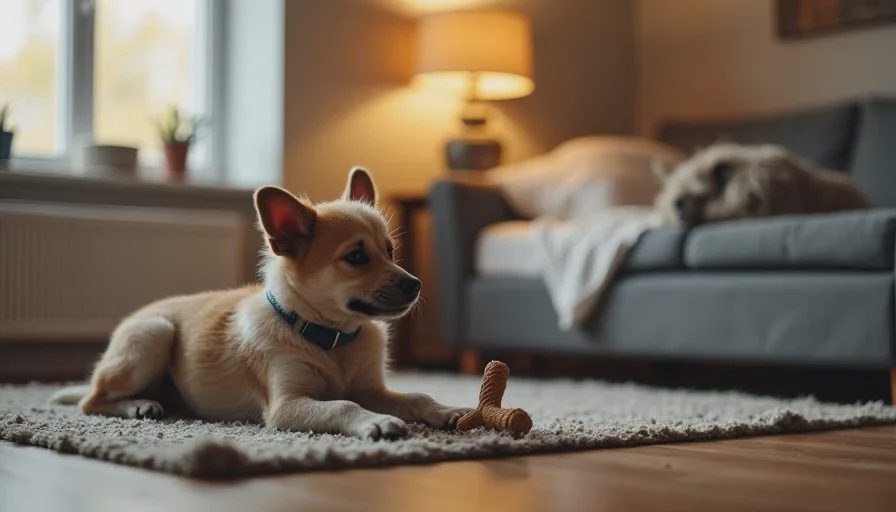
Our sequence does three jobs at once:
It provides a final legal outlet for residual energy and foraging drive.
It shifts the sensory environment toward quieter, more predictable input.
It makes the location of rest obvious and low-pressure for both dogs.
I keep the order consistent. Dogs notice patterns. The pattern itself becomes part of the cue that the day is settling.
Step 1: The Last Sniff, Not the Last March
If Ziggy still looks elevated in the late afternoon, we do not automatically add a brisk walk. We do a short, slow sniff session instead—long line or regular leash in a quiet area, no agenda except nose work. Five to fifteen minutes is often enough. The goal is not distance. The goal is to let him process the world through his primary sense and drop a layer of arousal.
Maple sometimes joins, sometimes stays home. At her age she is selective about optional outings, and I respect that. When she does come, the pace stays slow. This is not a conditioning walk or a social walk. It is a decompression valve.
If the day has already been heavy on activity, we skip even this and move straight to indoor wind-down. More is not always better once the bucket is close to full.
Step 2: Foraging as a Bridge
Back inside, both dogs get a simple foraging job. This is rarely a frozen Kong. More often it is scatter feeding on a mat, a snuffle setup, or a cardboard box with paper and a handful of food. The work is easy enough to complete without frustration and long enough to create a clear before-and-after.
Ziggy needs this more than Maple. The searching behavior gives his brain a job that ends cleanly. When the food is gone, the activity is over. That clean ending is useful. Open-ended play or extended training at this hour often keeps the motor running.
I feed them apart enough that neither feels the need to monitor the other. Parallel calm is the aim, not interaction.
Step 3: Lights, Sound, and Location
As the foraging finishes, the environment changes in small, consistent ways. Curtains or blinds adjust to reduce visual triggers from outside. The main overhead lights drop. A lamp comes on. If the household has been noisy, the volume falls.
Each dog has a clear resting place available. Maple’s preferred bed is protected. Ziggy’s mat or bed is ready with a legal chew if he still needs mouth work. I do not cue an elaborate settle every time. The setup itself does most of the work. When I do ask for a settle, the reinforcement is quiet and the duration starts realistic.
This is also the hour I stop asking for new learning. No new cues. No pushing through distractions. The training day is closed. What remains is management and recovery.
Step 4: Human Behavior That Matches
The dogs are not the only ones who need to change gear.
If I continue to move through the house at daytime pace, take work calls in the living room, or keep the energy conversational and bright, the wind-down competes with mixed signals. I am not rigid about this, but I am deliberate. Lower movement. Lower volume. Fewer transitions. The evening becomes recognizably different from the afternoon.
Ethan and I are not performing a spa ritual. We are simply avoiding the thing that used to keep Ziggy in a low-level monitoring state until ten or eleven at night—the sense that something else might still happen.

What Changed
The first result was practical. Fewer late-evening pacing loops. Fewer startle responses to ordinary sounds. A higher chance that both dogs would be deeply asleep before we were.
The second result was informational. When the wind-down is consistent and Ziggy still cannot settle, I treat it as data. Maybe the day stacked too many stressors. Maybe sleep the night before was poor. Maybe something in the environment needs adjusting. The routine gives me a clearer baseline so that residual restlessness stands out instead of blending into “this is just how evenings are.”
Maple’s presence helps. She commits to rest early and thoroughly. Ziggy has learned, slowly, that her choice is available to him as well. I do not force him to match her. I make the path to matching her as obvious as possible.
A Routine, Not a Script
This sequence bends when life bends. Travel, guests, late work, storms—any of these can disrupt it. The point is not perfection. The point is that on ordinary days the house has a known way of closing the active chapter. Dogs benefit from that kind of predictability. So do the humans who live with them.
I used to think calm evenings were something you earned only after the dog was “fixed.” In practice, calm evenings are part of the method. Recovery is not the prize at the end of behavior work. It is one of the conditions that make behavior work possible.
Ziggy still has restless nights. The difference is that they are no longer the default. Most evenings the motor finally switches off, Maple is already asleep, and the house feels like a place where both dogs can stop working.
That is the wind-down. Simple steps, same order, repeated often enough that the dogs recognize the shape of the end of the day.
Respect the dog.