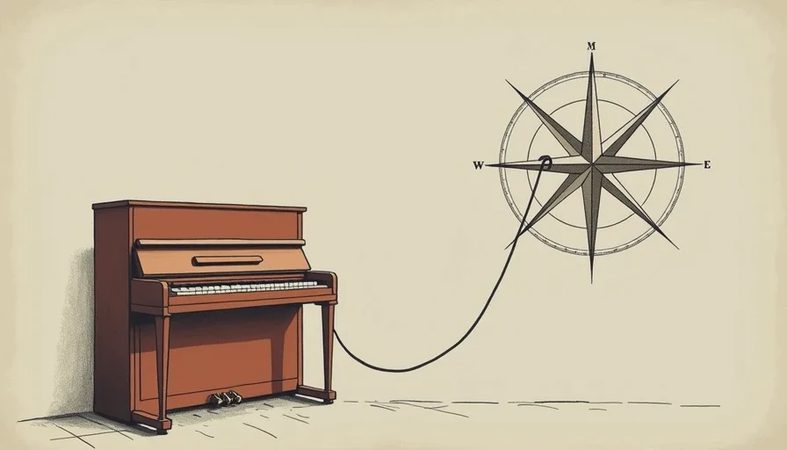
I am not a good pianist.
I can play simple pieces slowly. I can stumble through intermediate arrangements if no one is listening too carefully. The dogs, for a long time, were my primary audience because they had limited options for leaving the room. Maple mostly slept through it. Ziggy, in the early months, treated every imperfect chord like a personal threat.
Thunder was worse.
The first spring storm after he arrived turned him into a panting, pacing, wide-eyed mess. He tried to climb into the bathtub. He tried to climb into my lap. He refused food. The camera later showed him remaining elevated for nearly two hours after the last rumble. Noise sensitivity and separation distress often travel together; Ziggy had both.
I did the usual things. White noise. Closed blinds. A stuffed Kong that went untouched. I looked at commercial thunder recordings and desensitization tracks. Then I looked at the piano in the corner and had a deeply practical thought: I already own a device that can make low, rumbly, imperfect sounds on demand, at whatever volume I choose, and stop the moment I want it to stop.
It was not elegant. It was available.

Why a Bad Piano Was Actually Useful
Real thunder is uncontrollable. It arrives at full intensity, lasts as long as it lasts, and cannot be paused for a treat delivery. That makes it a poor training stimulus at the beginning. You need something you can grade.
A piano—especially one played by a mediocre human—gives you control. I could play single low notes. I could play soft clusters in the bass. I could stop instantly. I could repeat the exact same sound. I could keep the volume well below the level that made Ziggy leave the room.
The goal was never to make thunder sound like piano music. The goal was to give his nervous system repeated experiences of “low rumbly sound appears and nothing bad happens; in fact, good things appear.” Once that foundation existed, we could move closer to actual storm sounds.
I also needed the sessions to be sustainable for me. If the protocol required perfect recordings, special equipment, and a free hour every day, it would have collapsed under ordinary life. Sitting at the piano for eight or ten minutes in the evening was something I was already trying (and failing) to do for my own sake. Pairing it with Ziggy’s work made both more likely to happen.
How the Sessions Actually Went
We started absurdly easy.
Ziggy on a bed on the far side of the living room. Me at the piano. One soft low note. Immediate scatter of high-value treats on the floor near him—not from my hand at first, so he did not have to approach me while processing the sound. Then silence. Then another note. More treats. If he stayed settled, I continued. If he stood up, lip-licked hard, or moved away, I stopped and gave him more distance the next round.
Early sessions lasted only a few minutes. The bar for success was simply that he could remain in the room and keep eating. No requirement to look happy about the piano. No requirement to stay on the bed. Just: sound happens, food happens, sound stops.
Progress was uneven. Some evenings he was more available than others. If we had already stacked other stressors that day, I kept the piano work extremely light or skipped it. Trigger stacking does not care that you had a training plan.
After a couple of weeks he began to show the shift I look for in any counter-conditioning work: the sound would start and he would orient toward the treat area with clear expectation. The prediction was updating. Low piano noise was becoming a cue for chicken, not for doom.
Only then did I increase difficulty—slightly fuller chords, slightly longer sequences, moving his bed a little closer over many sessions. Still no attempt to mimic real thunder. We were building tolerance for controllable rumbly sounds and a positive association with their onset.
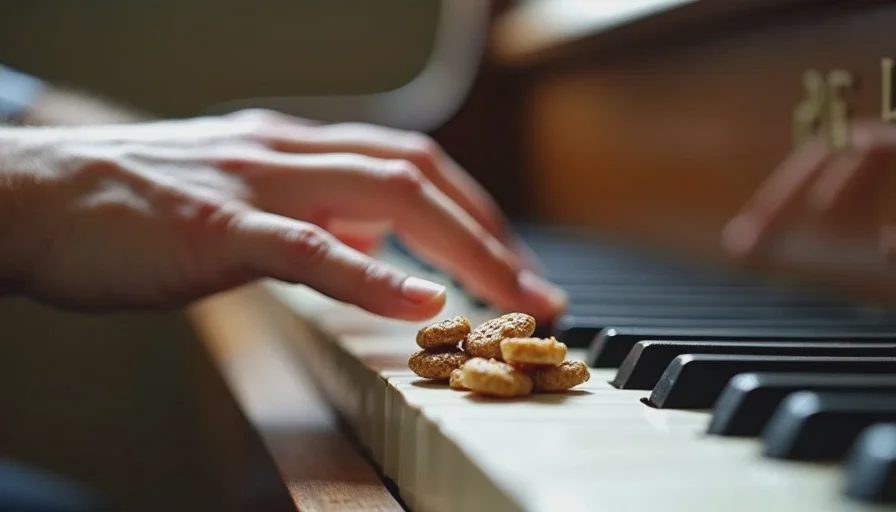
Bringing in Real Storm Sounds
Once the piano work was solid, I introduced recorded thunder at very low volume while continuing the same open-bar approach. The piano had given us a bridge. It was not magic; it was simply a way to rehearse the emotional pattern with a stimulus I could fully control.
Real storms still required management. We did not suddenly leave him alone with a full Texas thunderstorm and expect the piano work to carry the day. We used closed windows, background sound, presence when possible, and the same food pairing when the first distant rumbles appeared. The difference was that his recovery time shortened and the intensity of the panic dropped. He could take food sooner. He could settle again faster after the cell passed.
Maple remained largely unimpressed by the entire project. She had lived through many Austin storm seasons and had concluded that thunder was mostly irrelevant. Her calm presence in the room during early sessions probably helped more than I initially realized.
What This Story Is Actually About
It is easy to read a protocol and imagine a tidy sequence of perfect steps. Real desensitization with a real dog in a real house is messier. You use the tools you have. You adjust when the dog tells you the current level is too hard. You accept that some days the best decision is to do less.
The piano was not a clever hack that replaced proper behavior work. It was one controllable stimulus inside a larger process: stay under threshold, pair the onset of the sound with something genuinely good, raise difficulty only after the emotional response has shifted, protect recovery, and keep going longer than feels dramatic.
I still play poorly. Ziggy still prefers that I keep the volume moderate. But the last serious storm season looked different. He paced less. He recovered sooner. He could stay in the living room instead of trying to climb into the plumbing. That change was built in small, slightly ridiculous evening sessions with an imperfect pianist and a dog who was doing his best to tell me when I was pushing too fast.
You do not need a piano. You need something you can grade, a dog whose threshold you are willing to respect, and enough patience to let the new association form at the speed the nervous system can actually absorb.
Respect the dog.