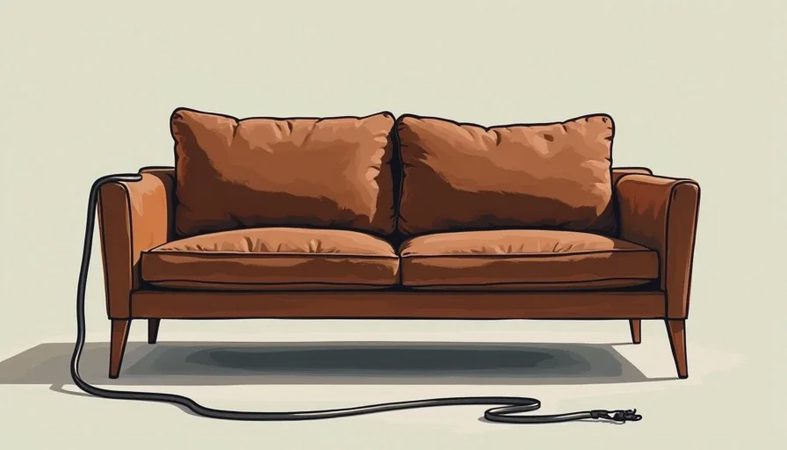
I used to think I was good at systems.
Eight years in product management will do that to you. You learn to break messy human problems into tickets, measure the right metrics, and ship something that mostly works. Then a 25-pound terrier mix named Ziggy arrived, and every system I had fell apart in under two weeks.
This is the story of how that happened, why the couch paid the price, and why this site exists.
The Couch Was Only the Beginning
Ziggy came from a local rescue. Three years old, medium energy on paper, “a little anxious but fine once he settles.” The foster family said he did okay in a crate for short periods. I believed them. I had spreadsheets ready. I had a carefully staged first-week plan that included short absences, high-value food toys, and a camera so I could watch him “settle.”
He did not settle.

The first time I left for a twenty-minute coffee run, the camera showed him pacing in tight circles, then barking, then grabbing the edge of the sofa cushion and shaking it like it had personally wronged him. By the time I got home the cushion was eviscerated. Foam everywhere. The kind of mess that makes you stand in the doorway and just stare.
I cleaned it up. I tried again the next day with a longer food toy. Same result, faster. Within a week the second cushion was gone, a baseboard had tooth marks, and I had cried more than once in the kitchen while Ziggy watched me from the other side of a baby gate, panting and unable to take a treat.
Maple, Ethan’s ten-year-old flat-coated retriever mix, observed all of this with the quiet dignity of a dog who had already lived through several human learning curves. She would occasionally walk over, give Ziggy a soft look, and then go lie on her bed as if to say, “This one is on you.”
I did what most of us do. I Googled. I bought the products. I followed the advice of well-meaning trainers who told me to “just let him cry it out” or “make departures more exciting so he doesn’t notice.” None of it helped. Some of it made him worse. The more I tried to force the behavior I wanted, the more Ziggy’s panic seemed to escalate.
That was the first real lesson: when a dog’s behavior looks like “destruction” or “stubbornness,” it is almost always communication. Ziggy was not trying to punish me for leaving. He was in a state of physiological panic. The research on separation-related distress is clear on this point—heart rate, cortisol, and behavioral markers of distress rise dramatically in affected dogs when left alone, even for short periods. What looks like “bad behavior” is often the only coping strategy the dog has left.
I stopped treating it like a training problem and started treating it like a welfare problem.
What Product Management Actually Taught Me
The turning point was not a single breakthrough moment. It was the slow realization that the same habits that made me decent at product work could be applied here—if I dropped the ego and the timeline.
I started logging. Not just “left for 15 minutes, chewed pillow.” Actual data: time of day, duration of absence, what enrichment was present, body language before I left, recovery time after I returned, whether Maple was in the house. I filmed the first five minutes of every departure and watched them the way I used to watch user session recordings. Patterns emerged. Ziggy’s threshold was lower in the late afternoon. He did better if Maple was visible. High-value food toys only helped if he was already under threshold when I left; once the panic started, food was irrelevant.
I read the literature. Papers on counter-conditioning, systematic desensitization, and the role of predictability in reducing anticipatory anxiety. I stopped looking for the three-day fix and started building a protocol that matched the dog in front of me.
Progress was slow and uneven. Some weeks felt like regression. There were days I sat on the kitchen floor after another failed short absence and wondered whether I had made a terrible mistake adopting him. Ethan was patient. Maple was unbothered. Ziggy kept trying to tell me, in the only language he had, that the world felt unsafe when I disappeared.
Eventually the absences got longer. The destruction stopped. The camera started showing a dog who could lie down, even sleep, while we were gone. Not because I had “fixed” him with a clever trick, but because we had systematically changed the emotional meaning of being alone.
That process is what led me to the IAABC certification. I wanted the formal framework and the ethics that come with it. I also wanted to stop feeling like I was inventing everything from scratch in the dark.

Why This Site Exists
Leash and Logic is the place I wish had existed when Ziggy first arrived.
Most of what I found online fell into one of three categories: pure science that never translated into what to do tomorrow morning, pure personal story that offered comfort but no method, or pure protocol that assumed every dog and every household was the same. Very few voices held all three at once—the research, the lived mess, and the concrete next step.
That is the gap I am trying to fill.
You will find science here, cited and explained in plain language. You will also find the parking-lot moments, the days I got it wrong, and the times Maple quietly corrected something I had missed. And you will find worksheets, decision trees, and traffic-light frameworks because I still think like a product manager: if it cannot be used, it is not finished.
I will not promise speed. Behavior change takes the time the individual dog needs. I will not recommend tools that work by creating fear or pain. And I will never frame a dog as stubborn, dominant, or “just being difficult.” Every behavior has a function. Our job is to understand that function and change the conditions that produce it.
Ziggy still has hard days. So do I. Maple is now eleven and teaching both of us what it looks like to age with grace and clear boundaries. The couch has been replaced. The cushions are intact.
This blog is what I built with everything I learned between the first shredded cushion and today. It is for the people who are standing in their own doorways staring at the mess, wondering what they did wrong. You probably did not do anything wrong. You just need better information, a clearer process, and permission to go at the pace your dog actually requires.
Respect the dog.