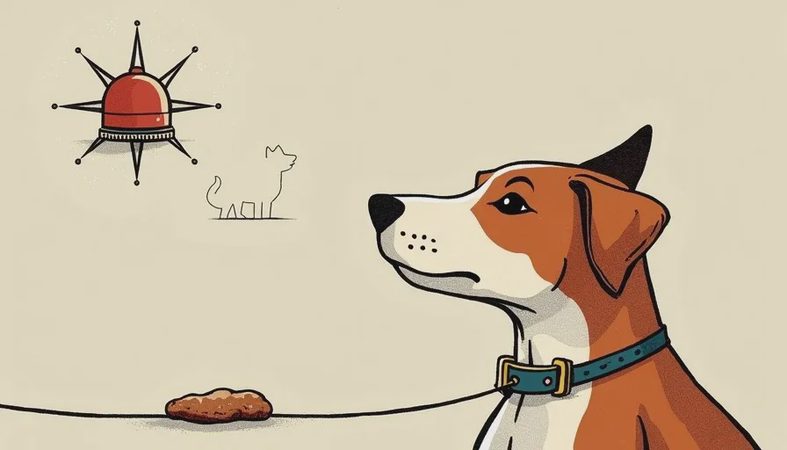
I spent months using the phrase “counter-conditioning” before I could explain it cleanly to another human.
That is a problem. If the people living with the dog cannot picture the process, the process does not leave the consulting room. So here is the version I wish someone had handed me when Ziggy was still melting down at ordinary sounds and ordinary departures.
What It Actually Means
Counter-conditioning changes the emotional meaning of something.
If a doorbell currently predicts “intruder, high alert, bark,” we arrange experiences where the doorbell reliably predicts “excellent food is about to appear.” Over enough careful repetitions, the dog’s nervous system updates the prediction. The sound starts to mean something better.
That is the entire core idea. We are not teaching a sit or a quiet cue in this phase. We are rewriting the feeling that shows up first.
Desensitization is the partner technique. It means we present the trigger at a low enough intensity that the dog notices it but does not tip into distress. Distance, volume, duration, and movement are all dials we can turn down. We stay under the dog’s threshold so learning can still happen. Then we pair that manageable version of the trigger with something the dog genuinely likes.
Most real-world protocols use both together. Gradual exposure keeps the dog functional. The positive pairing changes the association.

The Open-Bar Method in Plain Steps
The cleanest practical version is often called open bar / closed bar.
Identify the trigger and find the intensity at which your dog notices it but stays mostly functional. Soft eyes, ability to take food, no hard staring or lunging. That is your starting point.
Prepare food that is high enough value that the dog cares about it even with mild distraction. For many dogs this is real meat, cheese, or whatever that individual finds special. Kibble rarely cuts it here.
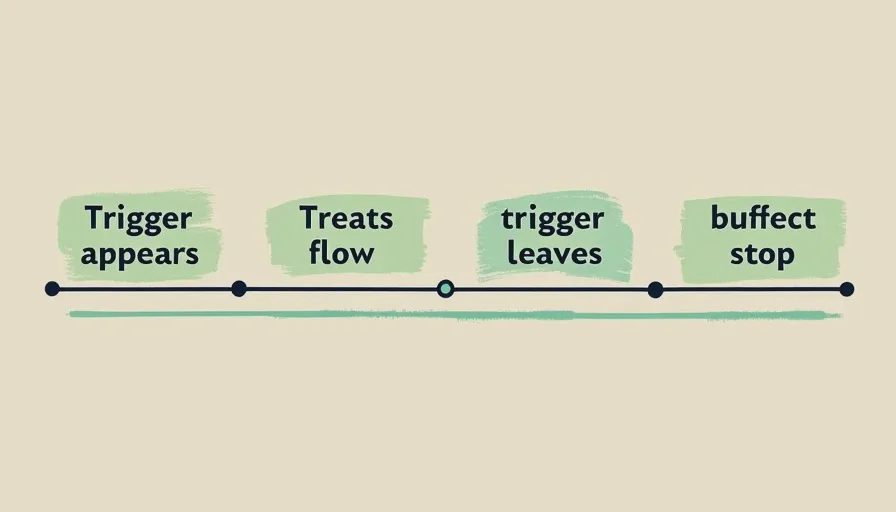
When the trigger appears at the working intensity, the bar opens. Food starts flowing in a steady stream of small pieces. You are not asking for a behavior. You are simply pairing.
When the trigger disappears or ends, the bar closes. Food stops.
Repeat at the same intensity until the dog’s body language shifts. The classic sign of progress is that the dog sees the trigger and looks to you (or the treat pouch) with clear expectation. That conditioned emotional response tells you the prediction is updating.
Only then do you raise the difficulty slightly—closer distance, slightly louder sound, a bit more movement—and build the new association again at the new level.
The order matters. Trigger first, then food. If you feed continuously with no connection to the trigger, you are just handing out snacks. The contingency is what builds the new meaning.
What Success Looks Like
Early success is quiet. The dog who used to stiffen at the sight of another dog now glances at it and then checks back for the next piece of chicken. The dog who used to pace at the first note of thunder now orients toward the treat pouch when the recording starts at low volume.
You are not looking for instant love of the trigger. You are looking for a change in prediction and a drop in the old distress signals.
Common places people get stuck:
Working too close or too intense too soon. If the dog cannot take food, you are over threshold. Back up.
Inconsistent pairing. If the trigger sometimes predicts food and sometimes predicts nothing (or worse), the association stays muddy.
Stopping the food the moment the dog looks away from the trigger. Keep the bar open for the full duration the trigger is present at that level.
Expecting the new association to hold in every context after a few sessions. Generalization takes deliberate practice across locations and conditions.
I used a version of this with Ziggy around departure cues and certain sudden noises. The progress was not dramatic day to day. It was visible week to week in the camera footage and in how quickly he could return to resting. The same principles apply to leash reactivity, veterinary handling, guest arrivals, and a long list of other triggers.
A Simple Tracking Sheet You Can Use
You do not need complicated software. A notes app or a piece of paper works.
Date | Trigger & intensity | Distance / volume / duration | Dog’s body language | Took food? | Notes / next step |
|---|---|---|---|---|---|
Record what you actually did and what the dog actually showed. Patterns become obvious. So do the days you accidentally pushed too hard.
Why This Is Worth the Patience
Fear and reactivity are not solved by flooding the dog with the thing they hate until they “get over it.” That approach often makes the association stronger. Counter-conditioning plus careful desensitization gives the nervous system new information at a pace it can absorb.
It is slow. It is repetitive. It requires you to become a careful observer of threshold. And it works more reliably than almost any other non-pharmaceutical approach we have for changing emotional responses to specific triggers.
You do not need to sound like a textbook to do this well. You need a clear picture of the process, food the dog values, and the discipline to stay under threshold while the new prediction forms.
That is counter-conditioning without the jargon. Trigger appears, good things happen. Trigger leaves, the good things stop. Repeat at a level the dog can handle until the feeling itself begins to change.
Respect the dog.