
I used to think Ziggy was unpredictable.
Some days he walked past other dogs with only a glance. Other days the same kind of dog at the same distance produced a full lunge-and-bark display that left both of us shaken. I searched for the difference in the other dog, the weather, the exact angle of approach. I was looking in the wrong place.
The difference was usually everything that had already happened before we ever left the house.
What Trigger Stacking Actually Is
Trigger stacking is the accumulation of stressors—big or small—that push a dog closer to their coping limit. Each event raises the baseline level of arousal or stress. If the dog does not have enough recovery time between them, the next event starts from a higher place. Eventually something that would normally be manageable becomes the thing that tips them over.
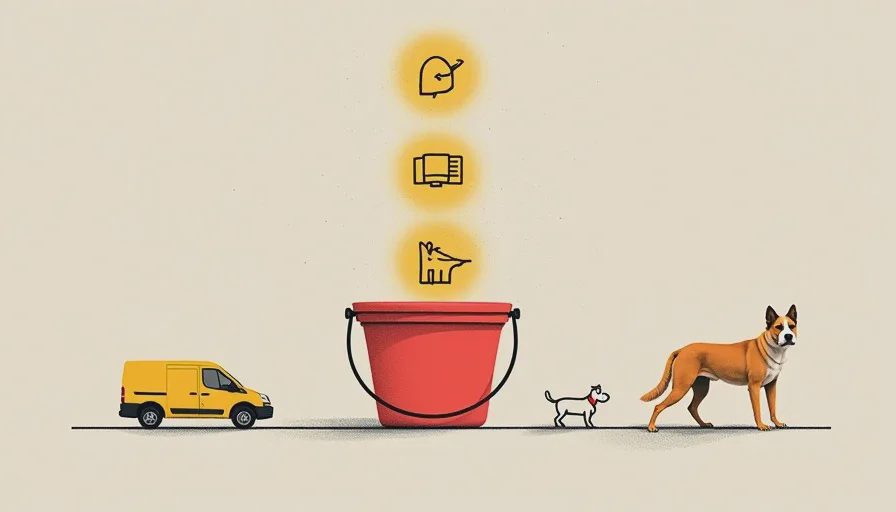
Think of it as a bucket. Every stressful or highly arousing experience adds water. Some add a little. Some add a lot. Rest, sleep, predictability, and successful decompression let water out. If the bucket fills faster than it empties, the overflow looks like a sudden overreaction to whatever was last on the list.
The final trigger is rarely the whole story. It is just the one that happened to be present when the system reached capacity.
This is why a dog can look “fine” with a particular stimulus on a quiet day and fall apart with the same stimulus after a hard morning. The stimulus did not change. The dog’s available capacity did.

A Real Ziggy Day
One Saturday last spring started ordinarily enough.
Ziggy had slept poorly because of overnight storms. Morning potty break included two barking dogs behind a fence we usually avoided. The mail carrier came earlier than usual and Ziggy practiced his door routine harder than I would have liked. A delivery truck idled outside for several minutes with the engine running. We attempted a short training session that went sideways because I was distracted. By early afternoon the house felt restless.
Late afternoon we went for what should have been an easy neighborhood loop. Midway down the block a plastic bag lifted in the wind and skittered across the sidewalk twenty feet away. Ziggy exploded—barking, lunging, completely unavailable. From the outside it looked like he had lost his mind over a bag. From the inside of his day it was the last unit of stress the system could absorb.
I had been watching the bag. I should have been watching the whole preceding twelve hours.
Maple, as usual, observed the aftermath with the calm of a dog who had already spent her reactive years and decided most things were not worth the energy. She has a higher threshold and better recovery. Ziggy’s bucket fills faster and empties more slowly. Same household, different nervous systems.
Why It Feels So Unpredictable
We are wired to notice the dramatic endpoint and ignore the quieter accumulation. The lunge is memorable. The slightly shorter sleep, the extra doorbell, the mild frustration during a training session, the background construction noise—those register as ordinary. Until they are not.
Stress and arousal are also not limited to obviously negative events. High excitement counts. A rowdy play session, a high-intensity training class, or a series of guests can raise the baseline just as effectively as something the dog dislikes. The body does not always sort “fun arousal” from “stress arousal” as cleanly as we wish it would.
Individual factors matter. Age, health, pain, sleep quality, hunger, and prior learning history all influence how much capacity a dog has on any given day. A dog recovering from illness or dealing with low-grade discomfort will often have a smaller bucket. So will a dog who has already been working hard at staying under threshold for weeks.
What to Do With the Information
Once you start seeing days in terms of cumulative load, management becomes more precise.
Protect recovery. After a hard event—vet visit, difficult walk, storm, visitors—deliberately lower the demands for the next stretch of hours or the next day. Cancel the optional outing. Keep the evening quiet. Let sleep happen.
Space the known stressors. If you know the dog struggles with the mail carrier, the neighbor’s dog, and car rides, avoid stacking all three into the same morning when you have a choice.
Watch the early signals more carefully on already loaded days. The same lip lick or weight shift that is mild on a fresh morning may be a stronger warning by afternoon.
Build in decompression as a regular practice, not only after obvious meltdowns. Sniffy walks, quiet chewing, settled rest in a low-traffic space—these are not luxuries. They are how the bucket empties.
When a reaction does happen, rewind the day before you rewrite the training plan. Ask what else the dog had already carried. Sometimes the most useful intervention is not more exposure work. It is better spacing and better recovery.
The Longer View
Trigger stacking does not mean your dog is broken or that progress is imaginary. It means capacity is finite and real. Dogs who have been working hard at behavior change are often living closer to their limit simply because rehabilitation itself requires effort. That makes thoughtful management part of the training, not separate from it.
I still misread days with Ziggy. The difference is that I now look backward along the timeline instead of only at the final moment. Most of the “out of nowhere” reactions had a somewhere. Once you can see the stack, you can start protecting the space between the layers.
Respect the dog.